Skip to content
The new Couples Contract is here: together on one phone, or apart on two. Start yours

Free quiz · About 6 minutes · For two

How do you show love? And does it land?

20 quick either-or questions about how you most often show love, then one ranking of how you like to get it. You each answer privately on one phone, then see how your ways of showing love line up with what the other likes most, and where they miss.

  • Your answers never leave your browser
  • About six minutes
  • Made for two, on one phone
  • Free, no account needed

Before you start

Who’s playing?

First names are optional. They stay on this device unless you ask us to email your results.

  1. The first player answers 20 quick either-or questions about how they show love, then one ranking of how they like to get it.
  2. Pass the phone. No peeking.
  3. The second player answers the same ones.
  4. Sit together for the reveal.

Runs in your browser. Your answers are never sent or saved.

Five ways to show love

Same five love languages, from the other side.

What each one looks like when you’re the one showing it. You probably do all five now and then; the quiz shows which you reach for most.

  • Words of affirmation

    Saying it: thanks, praise and encouragement, out loud or in writing.

  • Quality time

    Making room for them: plans together, real attention, phones away.

  • Acts of service

    Lightening their load: the chore, the errand, the coffee made before they ask.

  • Gifts

    Small, thoughtful things that say “I was thinking of you.”

  • Physical touch

    Closeness you can feel: a hug, a hand to hold, a shoulder rub.

How it works

How you give, how you get.

  • 120 either-or questions about what you actually do, not what you’d like to do. Each pairs two of the five.
  • 2One ranking at the end: the five in order for how you like to get love.
  • 3Then each of your ways of showing love, set against the other’s favorites: where it lands, where it’s close, and where it misses, with a tip for each.

Either-or questions force trade-offs you rarely face in real life, so read your results as leanings, not labels.

Private by design

Your answers are a diary, not data.

  • The quiz runs entirely in your browser
  • Answers are never sent to us or anyone
  • Answers aren’t saved, so a refresh starts fresh
  • No account. Your email only if you want the full results

Want a copy? Add your email on the results, or take a screenshot before you close the tab.

What the research says

Showing love counts. Landing it may count too.

  • We tend to give the way we like to get.

    In a study of 83 young couples, more than 8 in 10 people picked the same way for how they most show love and how they most like to get it. A study of 84 couples found people tend to give more of the kinds of love they like themselves, at least for acts of service, gifts and touch.

    Polk and Egbert, 2013; Coy and Rodriguez, 2023

  • A lot of love goes unnoticed.

    In diary studies of couples, about half the thoughtful things and sacrifices one partner reported went unnoticed by the other. Worth saying out loud now and then: “I did that for you.”

    Algoe, Gable and Maisel, 2010; Visserman et al., 2019

  • Matching isn’t the goal. Landing it might be.

    Couples whose favorite love languages match haven’t been found to be happier. But in a 2022 survey of 100 couples, the bigger the gap between what each partner wanted and what the other said they gave, the less satisfied both tended to be. A one-time survey can’t show cause and effect, and a 2024 review notes that getting love in any form might explain the link.

    Impett, Park and Muise, 2024; Mostova, Stolarski and Matthews, 2022

  • Kind words land bigger than we expect.

    People tend to underestimate how good their thank-you notes and compliments make the other person feel, and to overestimate how awkward it will make them feel, even with people they know well.

    Kumar and Epley, 2018; Zhao and Epley, 2021

Sources

  1. Chapman, G. (1992). The Five Love Languages: How to Express Heartfelt Commitment to Your Mate. Northfield Publishing. Now published as The 5 Love Languages.
  2. Polk, D. M., & Egbert, N. (2013). Speaking the language of love: On whether Chapman’s (1992) claims stand up to empirical testing. The Open Communication Journal, 7(1), 1-11. doi.org/10.2174/1874916X20130423001 (opens in a new tab)
  3. Coy, A. E., & Rodriguez, L. M. (2023). Affection preference, enactment, and relationship satisfaction: A dyadic analysis of love languages. Journal of Marital and Family Therapy, 49(4), 741-761. doi.org/10.1111/jmft.12655 (opens in a new tab)
  4. Algoe, S. B., Gable, S. L., & Maisel, N. C. (2010). It’s the little things: Everyday gratitude as a booster shot for romantic relationships. Personal Relationships, 17(2), 217-233. doi.org/10.1111/j.1475-6811.2010.01273.x (opens in a new tab)
  5. Visserman, M. L., Impett, E. A., Righetti, F., Muise, A., Keltner, D., & Van Lange, P. A. M. (2019). To “see” is to feel grateful? A quasi-signal detection analysis of romantic partners’ sacrifices. Social Psychological and Personality Science, 10(3), 317-325. doi.org/10.1177/1948550618757599 (opens in a new tab)
  6. Impett, E. A., Park, H. G., & Muise, A. (2024). Popular psychology through a scientific lens: Evaluating love languages from a relationship science perspective. Current Directions in Psychological Science, 33(2), 87-92. doi.org/10.1177/09637214231217663 (opens in a new tab)
  7. Mostova, O., Stolarski, M., & Matthews, G. (2022). I love the way you love me: Responding to partner’s love language preferences boosts satisfaction in romantic heterosexual couples. PLOS ONE, 17(6), e0269429. doi.org/10.1371/journal.pone.0269429 (opens in a new tab)
  8. Kumar, A., & Epley, N. (2018). Undervaluing gratitude: Expressers misunderstand the consequences of showing appreciation. Psychological Science, 29(9), 1423-1435. doi.org/10.1177/0956797618772506 (opens in a new tab)
  9. Zhao, X., & Epley, N. (2021). Insufficiently complimentary?: Underestimating the positive impact of compliments creates a barrier to expressing them. Journal of Personality and Social Psychology, 121(2), 239-256. doi.org/10.1037/pspa0000277 (opens in a new tab)

When you’re ready for more

Know what lands. Then write it down.

The Couples Contract has you each rank your love languages and say what you’d like to get from each other, then keeps going: 21 sections, answered together or apart, then signed. Not legally binding. Or keep it light with WhoIs?, the card game that settles who’s who.

Take the love language quiz too
9:41

Alex & Sam

Your contract

2 sections signed19 to go
  • Core ContractSigned
  • DatesSigned
  • Finances8 of 23
  • MovingNot started
  • What IfsNot started
  • Family and FriendsNot started

Digital · 21 sections · together or apart

  • Reveal your answers side by side
  • A signed PDF for both of you
  • Revisit reminders, so it grows with you
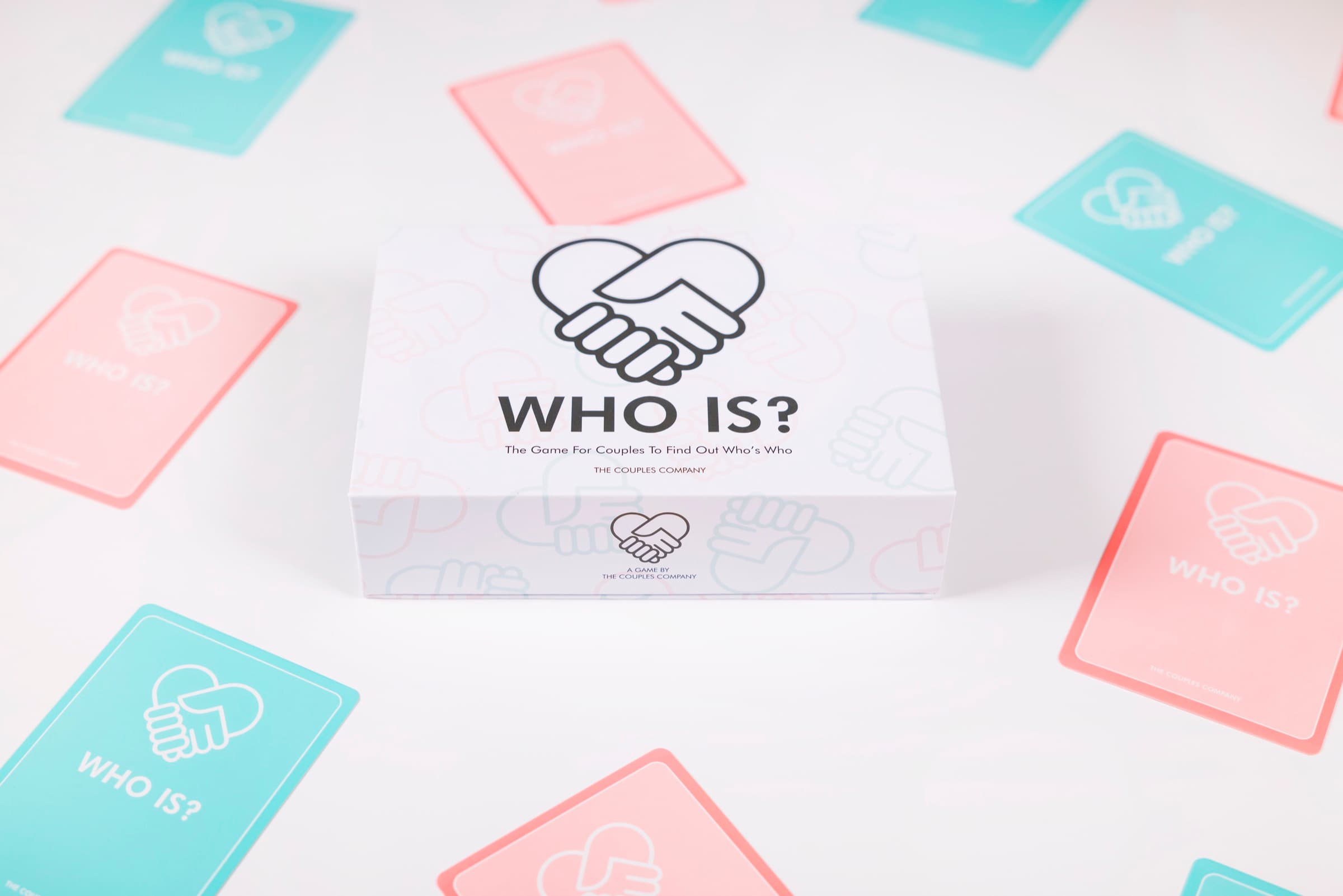
The WhoIs? card game box with pink and teal cards scattered around it

WhoIs? Card Game

$29.99

free US shipping

167 question cards · 12 answer cards · 2 to 12+ players

  • Play as a couple or with a group
  • Crown your Relationship Royalty
  • A magnetic gift box

Questions

Good to know

Is it really private?
Yes. The whole quiz runs in your browser. Your answers are never sent to us or anyone else, and they aren’t saved. Close the tab or tap Start over, and they’re gone. Your headline result shows straight away. To open your full results, add your email: we use your first names and results to send you a copy, and keep only your email address, which quiz you took and your headline result. Over the next week we send a few ideas and offers, and every follow-up email has an unsubscribe link.
How is this different from your love language quiz?
Our love language quiz asks what makes you feel loved. This one asks how you most often show love, then has you put the five in order for how you like to get it. Together, the two answers show whether your way of showing love lands with your partner.
Do we need two phones?
No, one is plenty. The first player answers 20 either-or questions and one quick ranking, then passes the phone. The second player does the same, then you look at your results together.
Can I take it on my own?
Yes. Answer your questions, then choose “See just your results” instead of passing the phone. You’ll see how you show love next to how you like to get it, and you can hand the phone to your partner afterward without starting over.
How are the results worked out?
Each question pairs two of the five ways to show love. Each one comes up 8 times, paired twice with every other one, so none gets a head start. The one you picked most is how you show love most. Your way of showing it “lands” when it’s in your partner’s top two for getting love, is “close” at third, and “misses” lower down.
What if the way I show love misses?
Keep doing it, and add a little of what your partner likes most. The results give each of you a tip that starts from what you already do.
Is this an official 5 Love Languages quiz?
No. The idea of love languages comes from Dr. Gary Chapman’s book The 5 Love Languages. This quiz is our own, and it isn’t affiliated with or endorsed by him or his publisher.